
Few technologies have been hyped as loudly — or understood as poorly — as blockchain. Strip away the buzzwords and speculation, and what remains is a genuinely clever idea: a way for people who do not trust each other to agree on a shared record without needing a bank, a government, or any single authority to referee. That shift, from trusting an institution to trusting math and open code, is why blockchain underpins cryptocurrencies, powers new kinds of digital ownership, and is quietly reshaping how supply chains, contracts, and identities can work. This guide explains how it actually functions and where it genuinely helps.
📊 What Is Blockchain Technology?
A blockchain is a distributed digital ledger — a record of transactions that is copied across many computers rather than stored in one central database. Instead of a single company holding the master copy, thousands of participants each keep an identical version, and new entries are only added when the network agrees they are valid. Once written, a record is extremely difficult to alter, because changing it would mean rewriting every copy at once.
Three properties do most of the heavy lifting:
- 🧱 Decentralization means no single party controls the ledger — the network is maintained collectively, so there is no central point that can be shut down, censored, or bribed to rewrite history.
- 🔒 Immutability means that once a block of transactions is confirmed and linked to the chain, it is effectively permanent — each block carries a cryptographic fingerprint of the one before it, so tampering breaks the whole chain.
- 👁️ Transparency means the ledger is openly verifiable — on public blockchains anyone can inspect every transaction, so trust comes from what everyone can check rather than what one authority claims.
Put simply, blockchain replaces “trust me” with “verify it yourself.” That single change is what makes the technology useful far beyond digital money.
🎯 Why Blockchain Matters
The strongest case for blockchain is not that it is trendy, but that it solves a specific, stubborn problem: how to coordinate value and record-keeping among parties who have no reason to trust one another. Where that problem is expensive, blockchain earns its keep.
It removes costly middlemen. Cross-border payments, escrow, and settlement traditionally rely on layers of intermediaries who each take time and fees. A blockchain can let two parties transact directly, settling in minutes rather than days and often at a fraction of the cost.
It creates tamper-resistant records. Because altering history means overpowering the entire network, blockchains produce audit trails that are exceptionally hard to forge. For supply chains, medical records, or land titles, that permanence is the whole point.
It enables programmable trust. Smart contracts let agreements execute themselves — funds release automatically when conditions are met, with no lawyer or bank verifying each step. This turns static contracts into living software that enforces its own terms.
It gives people ownership of digital assets. For the first time, a digital item — a coin, a token, a deed — can be provably scarce and truly owned by an individual rather than held on a company’s server. That is the foundation of cryptocurrencies, NFTs, and decentralized finance.
📈 The Core Concepts That Actually Matter
Blockchain is surrounded by jargon, and much of it obscures rather than explains. The concepts below are the ones that genuinely determine how a blockchain behaves — grouped into how it stores data, how it reaches agreement, and how it delivers value. Each includes a concrete example so the idea sticks.
How Data Is Stored
- 🧩 Blocks and chains — transactions are bundled into blocks, and each block references the previous one, forming an ordered, unbroken chain. Example: Bitcoin adds a new block roughly every 10 minutes, so the chain grows steadily and every block permanently anchors all the history before it.
- 🔑 Hashing — a cryptographic function turns any data into a fixed-length fingerprint; change one character and the fingerprint changes completely, exposing tampering instantly.
- 🌳 Merkle trees — transactions are summarized into a single root hash, letting a device verify that a specific transaction is included without downloading the entire block.
How the Network Agrees
- ⚖️ Consensus mechanisms — the rules by which scattered, distrustful nodes agree on which transactions are valid and in what order. Example: under Proof of Work, miners race to solve a hard puzzle, and the winner’s block is accepted because redoing that work to cheat would cost more than it’s worth.
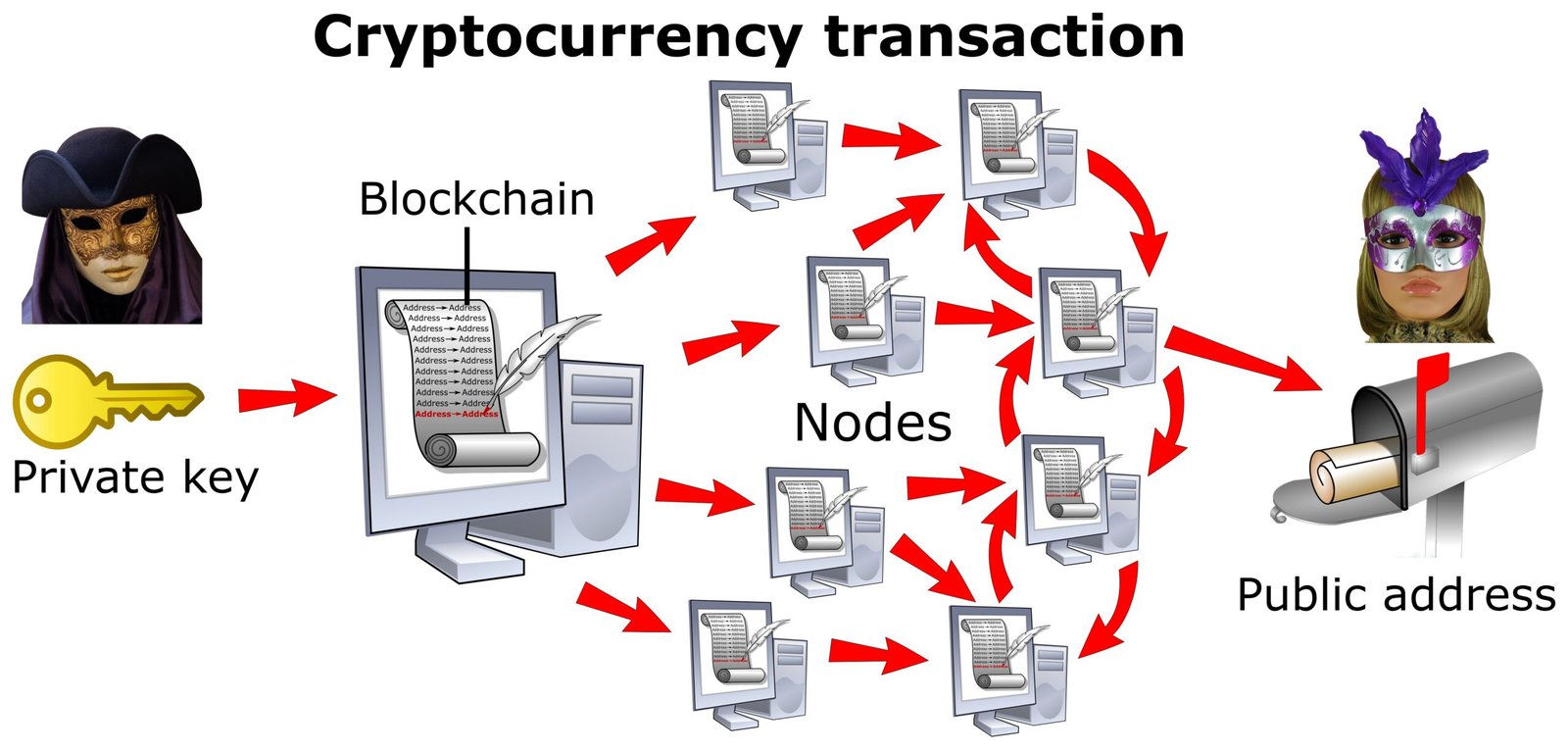
- 💻 Nodes — the computers that store the ledger and enforce the rules; the more independent nodes there are, the harder the network is to attack or control.
- 🔐 Public and private keys — your public key is like an account number others can send to, while your private key is the secret that authorizes spending. Example: lose your private key and your funds are gone forever — there is no “forgot password” on a true blockchain.
How Value Moves
- 📜 Smart contracts — self-executing code that runs on the blockchain and releases funds or triggers actions when agreed conditions are met, with no intermediary.
- 🪙 Tokens — units of value or rights issued on a chain, from currencies to shares in a project to tickets and collectibles.
- ⛽ Gas fees — the small payments users make to compensate the network for processing their transactions, which rise and fall with demand. Example: on Ethereum, a simple transfer might cost a few cents when the network is quiet but several dollars when it is congested.
⭐ The single most important idea: consensus without a central authority
Everything else — coins, contracts, tokens — is built on one breakthrough: a network of strangers agreeing on a single version of the truth without a trusted referee. Solve that, and you no longer need a bank or registry to prevent double-spending or forgery. Get the consensus design wrong, though, and the entire chain becomes slow, insecure, or centralized in practice, no matter how polished the app on top looks.
📋 Blockchain Cheat-Sheet (Quick Reference)
| Concept | What it is | Key trait | Where you meet it |
|---|---|---|---|
| 🧱 Block | A bundle of confirmed transactions | Linked to prior block | Every blockchain |
| 🔑 Hash | A data fingerprint | Any change breaks it | Blocks, wallets, IDs |
| 💻 Node | A computer running the ledger | More = more secure | Full nodes, validators |
| 📜 Smart contract | Self-executing on-chain code | Runs automatically | Ethereum, Solana |
| 🪙 Token | A unit of value or rights | Fungible or unique | DeFi, NFTs, games |
| ⛽ Gas fee | Cost to process a transaction | Varies with demand | Every transfer |
| 🔐 Private key | Secret that authorizes spending | Never share it | Your wallet |
🛠️ The Major Platforms You Should Know
Blockchain is not one network but many, each with different trade-offs between speed, cost, security, and decentralization. The list below covers the platforms most people encounter first — the right choice depends on what you are building or using, not on which name is loudest this month.
| Platform | Best for | Public? | Difficulty |
|---|---|---|---|
| ₿ Bitcoin | Digital store of value | Yes | Easy |
| ◆ Ethereum | Smart contracts & apps | Yes | Medium |
| ◎ Solana | High-speed, low-cost apps | Yes | Medium |
| 🔷 Polygon | Cheap Ethereum-compatible scaling | Yes | Medium |
| 🏦 Hyperledger Fabric | Private enterprise networks | No | Hard |
| 🔗 Chainlink | Feeding real-world data on-chain | Yes | Hard |
| 🪙 Stablecoins (USDC/USDT) | Steady-value payments | Yes | Easy |
A newcomer should start by using an established public chain before ever thinking about building on one — the discipline of holding a wallet safely matters more than the platform you pick.
🔗 Understanding Consensus Mechanisms
Consensus is how a blockchain decides which transactions are real and who gets to add the next block. The mechanism a chain chooses shapes its speed, energy use, and how decentralized it truly is — so it is worth knowing the main models before you judge any network.
| Mechanism | How it secures the chain | Best for | Watch out for |
|---|---|---|---|
| ⛏️ Proof of Work | Miners spend computing power | Maximum security, Bitcoin | High energy use, slower |
| 💰 Proof of Stake | Validators lock up coins | Energy-efficient smart-contract chains | Can favor the wealthy |
| 🗳️ Delegated Proof of Stake | Voters elect block producers | High throughput apps | Fewer, more central validators |
| 🤝 Proof of Authority | Trusted, known validators | Private and consortium chains | Not truly decentralized |
| 🧮 Byzantine Fault Tolerance | Nodes vote to tolerate bad actors | Enterprise and permissioned use | Scales poorly with many nodes |
No mechanism is best for everything — each trades away something. Proof of Work buys unmatched security at the price of energy and speed, while Proof of Stake and its variants gain efficiency and throughput but must work harder to stay genuinely decentralized. A network built for a private business rarely needs the costly security a public currency demands.
🧭 7-Step Framework for Evaluating a Blockchain Project
Because the space is crowded with hype and outright scams, a clear checklist protects you before you invest time or money. Work through these steps in order — each one filters out a common way projects go wrong.
💡 Worked Example: A Coffee Brand Uses Blockchain
Aarav runs a small specialty coffee company and wants to prove to customers that his beans are genuinely fair-trade and single-origin — a claim rivals make loosely and buyers cannot verify. Here is how he applies blockchain sensibly rather than as a gimmick:
- 🎯 The problem: Customers distrust “fair-trade” labels because no one can check the journey from farm to cup.
- 🔗 The chain choice: He records each step — harvest, export, roasting, packaging — on a public blockchain via a supply-chain platform, so entries cannot be quietly edited later.
- 📱 The customer experience: Each bag carries a QR code that opens the bean’s verified history, including the cooperative that grew it and the date it was roasted.
- 🧾 Why it works: Because every handler signs their step with a key and records are immutable, a fake “single-origin” claim would require corrupting the whole trail — far harder than printing a sticker.
- ✅ The result: Aarav charges a premium his customers accept, and returns drop because buyers trust what they can independently verify.
Notice that the blockchain here is a tool for verifiable trust, not the product. That is exactly the kind of problem the technology was built to solve.
⚠️ Common Blockchain Mistakes to Avoid
Confusing blockchain with cryptocurrency. Crypto is one application of blockchain, not the whole technology. Dismissing the ledger because you distrust speculative coins throws out a useful tool.
Using a blockchain where a database would do. If you control all the data and trust the participants, a normal database is faster, cheaper, and simpler. Blockchain only pays off when trust is the actual problem.
Ignoring key management. Losing your private key means losing your assets permanently, and sharing it means handing them away. Treat keys and recovery phrases with more care than any password.
Chasing hype and returns. Many tokens are pure speculation dressed up as innovation. Judge a project by the problem it solves, not by how fast its price is rising.
Assuming “immutable” means “correct”. A blockchain faithfully preserves whatever was entered, including mistakes and lies. Garbage recorded on-chain is permanent garbage — the data is only as good as its source.
Overlooking scalability and cost. Some chains slow to a crawl and charge steep fees when busy. Understand a network’s real-world throughput before building anything that depends on speed.
📖 Glossary of Key Terms
- 🧱 Block: A batch of validated transactions bundled together and cryptographically linked to the previous block.
- 🔑 Hash: A fixed-length fingerprint generated from data; any change to the input produces a completely different hash.
- 💻 Node: A computer that stores a copy of the blockchain and helps enforce its rules.
- 📜 Smart contract: Code stored on a blockchain that executes automatically when its conditions are met.
- 🔐 Private key: The secret credential that proves ownership and authorizes transactions from a wallet.
- ⛏️ Consensus mechanism: The method a network uses to agree on which transactions are valid, such as Proof of Work or Proof of Stake.
- 🪙 Token: A digital unit issued on a blockchain representing value, ownership, or access rights.
- 🌐 Decentralized application (dApp): Software that runs on a blockchain network rather than on a single company’s servers.
❓ Frequently Asked Questions
Is blockchain the same thing as Bitcoin?
Is blockchain actually secure?
Why do people say blockchain uses so much energy?
Can transactions on a blockchain be reversed?
What is a smart contract in plain terms?
Do I need to buy cryptocurrency to use blockchain?
What is the difference between public and private blockchains?
What are gas fees and why do they change?
Is blockchain only useful for finance?
What happens if I lose my private key or recovery phrase?
How do I start learning about blockchain safely?
🏁 Conclusion
Blockchain is neither the magic that its loudest promoters claim nor the fraud that its harshest critics dismiss. It is a specific engineering solution to a specific problem — coordinating trust among parties who have no reason to trust each other — and where that problem is real and costly, it delivers something genuinely new. Understand the fundamentals of blocks, keys, consensus, and smart contracts, and most of the noise around the technology becomes easy to see through.
The best way to cut past the hype is to keep asking one question: what problem does this actually solve, and does it truly need decentralization to solve it? Projects that answer clearly are worth your attention; those that cannot are usually selling speculation dressed as innovation. Learn the basics well, protect your keys, and judge every project on substance, and you will navigate this space with far more confidence than the crowd chasing the next price spike.
👉 Next step: Set up a free block explorer in your browser, look up a single real transaction on a public chain, and trace how it links back through the blocks. Seeing the ledger work firsthand teaches more than any amount of reading — start there this week.
